How to Compare AI Model Token Prices Without Getting Confused
When you are shopping for a cheap AI model API, the first thing that catches your eye is usually the per-token price. But that number alone does not tell you much. Token pricing can be structured in several ways, and the cheapest rate on paper may end up costing you more in practice. This article walks through the main points to check when comparing AI model token prices, so you can pick the option that actually fits your usage.
Understand What a Token Actually Is
Before comparing prices, it helps to know what a token represents. In most large language models, a token is a chunk of text. A token can be as short as one character or as long as one word. For English text, a rough rule of thumb is that 100 tokens equal about 75 words. But the exact count depends on the model's tokenizer. Some models split words differently, which means the same sentence can have a different token count across providers. When a provider quotes a price per token, always check how they define that token. If the definition is not clear, ask. A small difference in tokenization can add up fast when you are processing large volumes of text.
Input Tokens vs. Output Tokens
Most APIs charge separately for input tokens (the text you send to the model) and output tokens (the text the model generates). The prices are almost never the same. Input tokens are usually cheaper because the model only reads them once. Output tokens cost more because the model has to generate each one, which uses more compute. When you compare two providers, do not just look at their input token price. Look at the output token price too. If your application generates long responses, the output token cost will dominate your bill. Conversely, if your use case is heavy on input (like processing long documents), the input token price matters more. Always calculate a blended rate based on your expected ratio of input to output tokens.
Check for Hidden Fees and Minimum Commitments
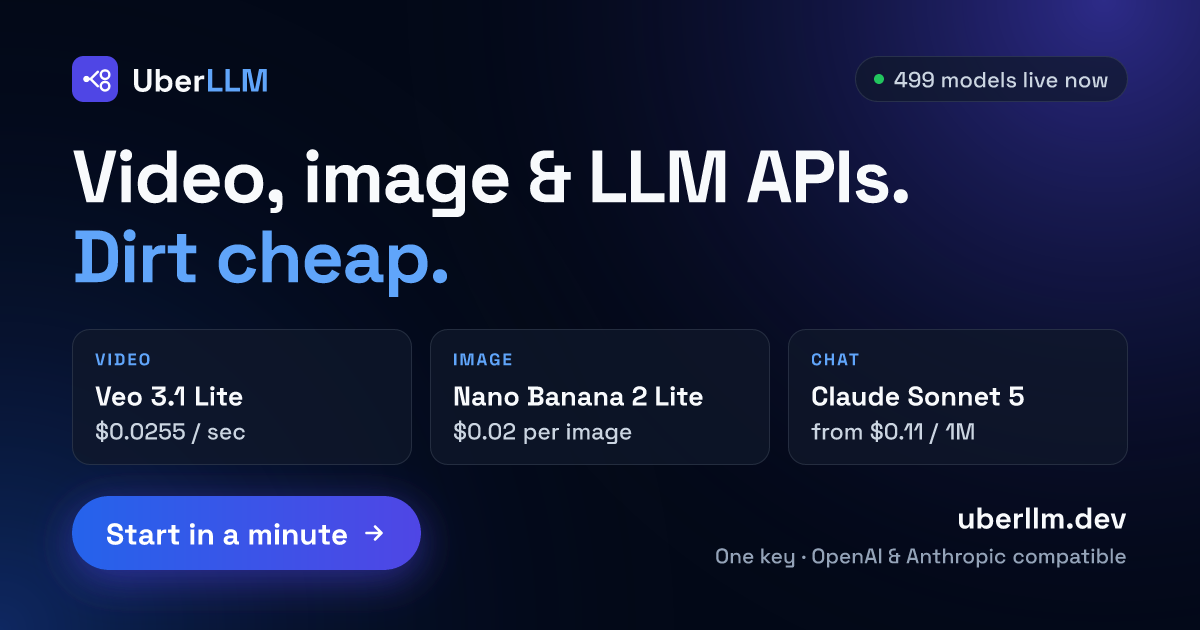
A cheap AI model API might advertise a low per-token price but add fees elsewhere. Some providers charge a monthly subscription fee, a per-request fee, or a fee for high request volumes. Others require you to buy a certain number of tokens in advance, and unused tokens expire. Still others have a minimum spend per month. To get a true comparison, add up all the costs you will actually incur. If you are a low-volume user, a flat monthly fee can make a cheap per-token price expensive. If you are a high-volume user, a per-request fee can eat into your savings. Look for providers that offer transparent pricing with no hidden charges. For example, uberllm.dev provides one OpenAI and Anthropic compatible API for accessing LLM, image, video and music models through competing sellers at prices below list rates with no subscription or fee on requests. That kind of structure removes a lot of the guesswork.
Look at Usage Limits and Rate Throttling
Even if the per-token price looks good, you need to check how much you can actually use the API. Many providers cap the number of requests per minute, per hour, or per day. If you exceed those limits, your requests may be delayed, queued, or rejected. Some providers also throttle the speed of response. A cheap API that is too slow for your application is not really cheap. Check the documentation for rate limits and response time guarantees. If the provider does not publish these numbers, that is a red flag. You can run a small test script to see how the API behaves under load. The goal is to find a provider that can handle your peak request volume without slowing down or costing extra.
Compare Token Pricing Across Models
Not all models are created equal, and neither are their token prices. A provider may offer several models at different price points. A cheaper model might be fine for simple tasks like summarization or classification, but a more expensive model might be necessary for complex reasoning or creative writing. When comparing prices, make sure you are comparing the same model or at least models of similar capability. Some providers also offer fine-tuned versions of a base model, which may have different token pricing. If you need the best performance for a specific task, check the pricing for that specialized model. Do not assume that the cheapest model overall is the best value for your use case.
Consider the Cost of Monitoring and Billing
Keeping track of your token usage and costs is part of the real expense. Some providers give you a dashboard with real-time cost monitoring, billing balance alerts, and usage logs. Others make you estimate your own usage or wait for a monthly invoice. If you need to stay within a budget, look for a provider that offers clear cost monitoring tools. You should be able to see your token count per request, per session, and per day. Good billing transparency helps you avoid surprises and adjust your usage before you run over budget. Without these tools, you are flying blind.
Evaluate the Quality of the API Documentation
Token pricing is only one part of the story. You also need to know how to integrate the API, what parameters are available, and how to handle errors. Good documentation saves you time and reduces the risk of mistakes that can cost you money. For example, if the documentation does not clearly explain how to set the maximum number of output tokens, you might accidentally let the model generate a long response that costs more than you intended. Check that the provider gives clear examples, code snippets, and a reference for all endpoints. A well-documented API is usually a sign that the provider is serious about making the service easy to use.
Test with Your Own Data
No amount of research replaces a real test. Before committing to any provider, run a small batch of requests with your actual data. Measure the token count, the response time, and the total cost. Compare this to what the provider's pricing page led you to expect. If the numbers do not match, you have a problem. Some providers have hidden tokenization costs that only appear when you use certain characters or languages. For instance, non-English text can have a higher token count because the tokenizer splits it into more pieces. A test run with your real data will reveal these issues. It also gives you a chance to check the quality of the model's output. Cheap is no good if the model cannot do what you need it to do.
Look for a Unified API
Managing multiple API keys, billing accounts, and authentication methods across different providers is a headache. Some services offer a single API that gives you access to models from multiple sellers. This simplifies your integration and lets you switch between models without changing your code. It also centralizes your cost monitoring and billing. For example, uberllm.dev provides one OpenAI and Anthropic compatible API for accessing LLM, image, video and music models through competing sellers at prices below list rates with no subscription or fee on requests. That kind of setup can save you time and reduce the risk of errors. When you compare token prices, factor in the cost of managing multiple integrations. A slightly higher per-token price from a unified API might be cheaper overall once you account for the reduced overhead.
Keep an Eye on the List Price vs. Actual Cost
Providers often advertise a list price that applies only to the base model under ideal conditions. The actual cost per token can vary based on factors like the model version, the length of the input, and the time of day. Some providers discount off-peak usage or offer volume discounts. Others charge a premium for high-priority requests. Always check the fine print. If the provider publishes a price table, read it carefully. Look for any notes about additional charges. If you can, negotiate a custom rate for high volume. Many providers are willing to work with heavy users to keep them as customers.
Comparing AI model token prices does not have to be confusing. Focus on the total cost of ownership for your specific use case. Understand how tokens are counted, factor in all fees and limits, test with real data, and choose a provider that gives you transparent pricing and good tools. With a systematic approach, you can find a cheap AI model API that meets your needs without hidden costs.